
Going All In: A Semiconductor Giant’s Journey Towards Going AI-Native
We didn’t design the mandate. We didn’t pick the use cases. We showed up to build what we were asked to build (and, incidentally, to prove that we could succeed with the hardest problems — but that’s a story for another day).
Most companies talk about becoming “AI-native.” Few actually build the muscle for it.
This is the story of how one global semiconductor company, a fabless chipmaker whose silicon powers much of the world’s data infrastructure, spent a year doggedly experimenting with AI until they started to get it right. Because leadership had decided on a bold plan: that the only way to get an organization genuinely fluent in AI was to let multiple IT teams try, stumble, fall, and then dust themselves off and try again, before anyone tried to write a five-year strategy.
SmartBots AI was one of the partners invited along for that year.
We didn’t design the mandate. We didn’t pick the use cases. We showed up to build what we were asked to build (and, incidentally, to prove that we could succeed with the hardest problems — but that’s a story for another day).
A Mandate, Not a Roadmap
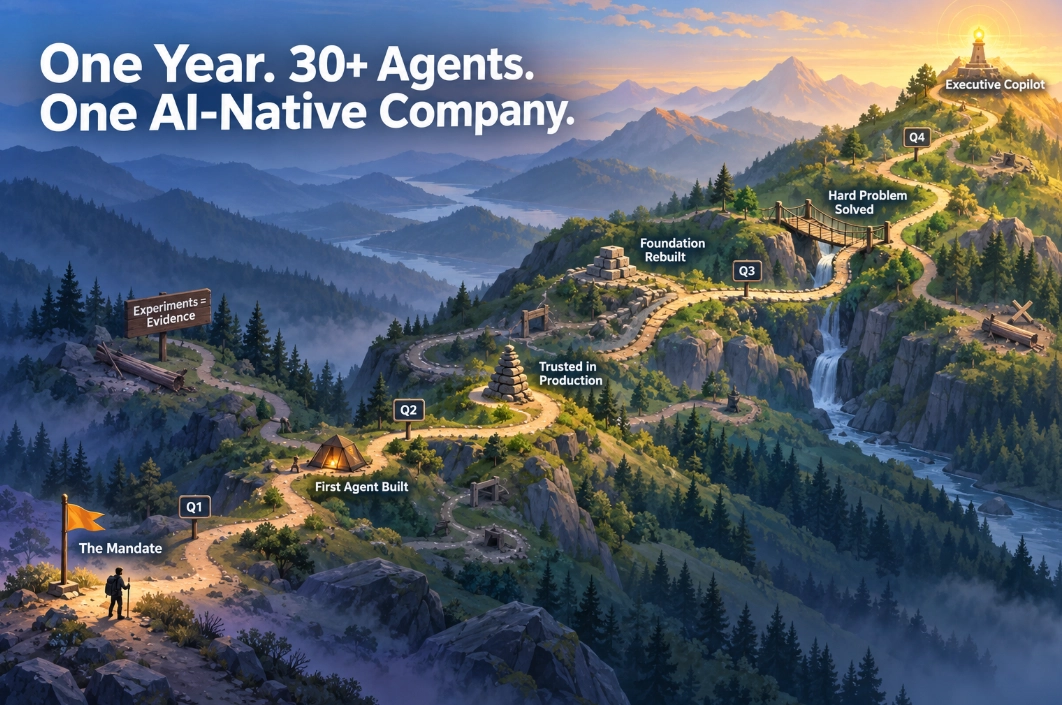
The instruction from IT leadership was simple: every IT team, each already aligned to two or three of the company’s target functions, would build five AI agents. Across three to four IT teams, that added up to 30+ agents in flight at once — some built by internal engineers, some by other AI vendors. Five of these were taken up by SmartBots AI.
There was no single grand architecture behind this. The point wasn’t to get 30 agents into production. It was to get an entire organization hands-on with agentic AI in a single year, so that whatever strategy came next would be grounded in real experience instead of a slide deck. Leadership’s own attitude was clear: take risks. Don’t be shy of taking risks. Let’s become AI-savvy sooner rather than later; better to find out in month three that an idea doesn’t work than to discover it two years into a roadmap.
That appetite for risk is the part of this story that’s easy to skip past. But it’s actually the part that matters most. Plenty of enterprises will fund one AI pilot and call it innovation. This company funded more than 30 of them, knowing that some might fail to take off. They chose to have a can-do spirit and look at the positives that might result from their year of experimentation.
And, as it turned out: their bet paid off. Quite well, in fact.
The First Bet: A Day’s Work in a Minute
The earliest use case was almost deliberately unglamorous. Every chip the company designs carries a “part profile” — foundry, country, customer, financial group. Before 2024, slicing that data a new way meant the Supply Chain team filing a request and waiting on the data team to write SQL. A handful of ad-hoc questions could eat a full day.
SmartBots AI built a natural-language-to-SQL agent so the Supply Chain team could ask questions in plain English and get answers straight from the database. It took two months to build and another four for the organization to trust running it in production — itself a sign of how seriously this company treated the transition from prototype to something people would actually rely on. The result: turnaround time dropped by roughly 70%, and a day’s work started taking about a minute.
It wasn’t a dramatic use case. But it was the first proof that betting on agents could pay off, and it earned the next request.
Betting Bigger, Then Betting on the Right Foundation
The next ask scaled the same idea across billing, backlog, and revenue forecasting — a natural-language interface over millions of rows spanning finance, supply chain, and sales ops, so planners and leadership could see revenue risk without waiting on a report cycle.
This Business Intelligence (BI) agent was built the way the first project had been built: a custom application, no shared platform underneath. That was fine at pilot scale. At this scale, however, it started to strain.
The company’s own data team — already running on Databricks — pushed for a different foundation: move the data onto Databricks and re-platform the agents on its native agentic AI stack, with data, orchestration, and hosting living in one place. That decision belonged to the client, and it reshaped every agent that came after. Quality, royalty, HR — all of it was built the Databricks way from Day One because this team chose to unwind working software and rebuild it on stronger ground.
The BI Agent turned out to be more than an internal reporting tool. It shrank a weekly reporting cycle down to daily, with impact estimated in the tens of millions of dollars from that single agent. The company’s CEO now uses it directly. And the underlying idea — that an agent’s power comes less from clever prompting and more from a well-built “meaning layer” that correctly recognizes what an entity in the data actually refers to — has since started showing up in competitors’ pitches. Our BI agent got there first: context-heavy, not prompt-heavy. Every enterprise, in this team’s view, should own that meaning layer for itself rather than rent it.
The Agent Two Other Teams Couldn’t Build
Not every use case was about speed. Royalty payments — the money owed when a chip design uses another company’s IP — are governed by legal agreements buried in PDFs, not clean database rows. Getting a number wrong here doesn’t just cost time; it can trigger a dispute.
This is the use case that tested how far the company was willing to push its “it’s OK if things don’t work out, but we’re still willing to try” mandate. The other AI vendor working on the multi-agent effort took a run at it and stepped back. The internal team tried and didn’t get there either. It would have been easy, at that point, to conclude the problem simply wasn’t solvable with the tools at hand and move on.
Instead, the client handed the project to SmartBots AI for a second attempt. Two agents now do the work: one extracts royalty rules from the underlying contracts, the second applies those rules to calculate what’s owed, with an operational dashboard giving the business a single view of contracts, extracted rules, and transactions together. A financial analyst still reviews the extracted rules, and the business still approves the calculations before anything goes out the door. The system runs at 95% accuracy in testing, with the client pushing for tighter precision before it goes fully live.
What stayed with us from this one wasn’t the metric. It was watching a company keep betting on a problem after prior attempts had failed, because the value of solving it was worth another try.
What This Year Actually Taught Us All
Thirty agents in, only a handful have reached production today; the others are currently a work in progress, and the company and their partners, including us, are working towards getting them to production.
That’s not a hidden footnote — it’s close to the point. Our client treats all experiments as evidence collected, not time wasted. Each attempt, working or not, has left their internal teams more fluent in what agentic AI can and can’t do yet.
A quality-control assistant that reads scattered compliance certificates and sensitivity sheets now answers material-composition questions in seconds instead of the 7 to 20 minutes engineers used to spend digging through documents by hand. An HR use case — technically the simplest of the group, but the one demanding the most care around data sensitivity — has already proven stable enough that a second phase is being planned. And because the underlying data across finance, quality, supply chain, and HR now sits on one governed platform, and there are agents on top of each of these functions, the company’s most recent request wasn’t for another department tool at all — it was for an executive copilot built on top of all these agents, customized for each C-suite leader. This multi-agent system pulls live figures, ranks risks, and flags what needs attention that morning in seconds, and provides a summary of the most critical business metrics to each C-suite executive.
Another heartening development relates to adoption. Earlier, adoption was a challenge; employees would start using the agents enthusiastically but later, usage tapered off. Now, as it turns out, Claude has become popular — and our client has been quick to note this and use it to their employees’ advantage. Within their org, Claude works with data pulled out by our agents and uses it to generate reports, so employees get the best of both worlds; they get a state-of-the-art interface and make it work with governed, regulated data that we’ve built the architecture to retrieve. It’s a win-win for employees as well as the company, and it wouldn’t have been possible without the company being proactive about adopting AI solutions right from the start.
A year after they started, our clients are now way ahead of the game. And they show no signs of slowing down.
The Hero of This Story
It would be easy to tell this as a vendor story: SmartBots AI built the toughest agents, including the one two other teams couldn’t crack, and earned a reputation inside the account as the team you call when something’s genuinely hard. That reputation is real, and we’re proud of it. But it isn’t the story.
The story is a company that chose, at a leadership level, to spend a year on purpose-built risk — 30+ agents, several teams, more than one outside partner, and an explicit mandate to fail fast rather than plan slow. Most of those agents didn’t survive. The organization that built them did, and it came out the other side genuinely fluent in what agentic AI is good for, run by people who’d actually built it, broken it, and rebuilt it themselves.
That’s what it looks like when a company decides to go AI-native: not a single sweeping rollout, but a year of educated risk-taking. And we, their partners, have been privileged to witness it.
Share this article by link or share it with your team